Argument

Slave ads expose the brutality of slavery not only in its economic commodification of human beings but also in its systematic attempt to erase their humanity, criminalize solidarity, and sever family bonds. Yet, paradoxically, these ads also testify to enslaved people’s resilience and resistance, since every notice is evidence of someone’s refusal to remain enslaved.

Primary Sources

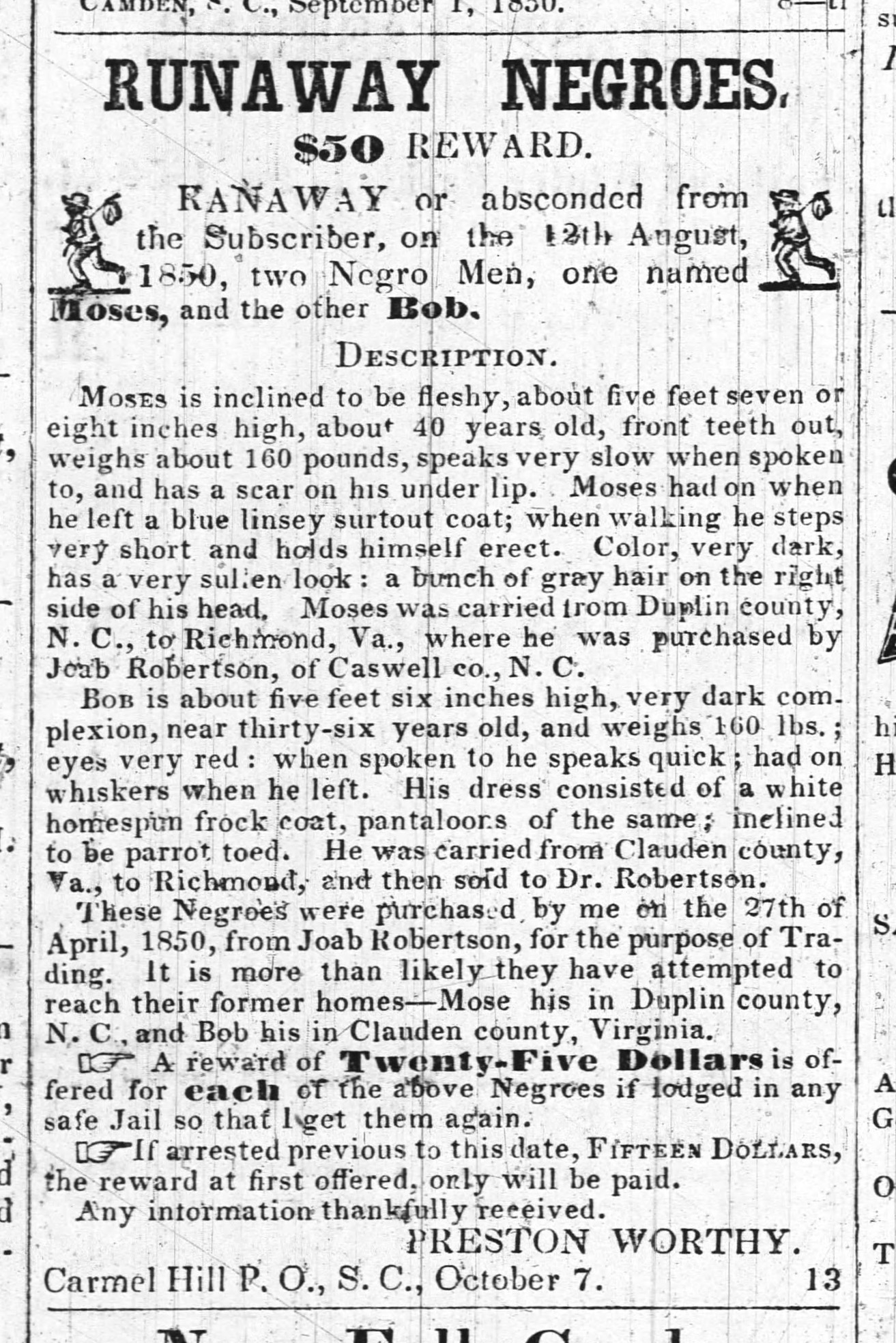
"Runaway Negroes" advertisement in Hornet's Nest and True Southron Newspaper - 1850
[Author/Creator] | [Date] | [Location/Archive]

Description of Source 1

Context

In the decades leading up to the American Civil War there was growing tension between Southern 'slave' states and Northern 'free' states over the question of slavery. One of the largest points of friction on a practical level was the legal status of runaway slaves. Southern slave owners saw these fugitives as their property with legal status similar to livestock and, as such, expected that these runaway slaves be returned into their control. Slaves were often even branded with their owner's mark much the same way that livestock or timber was, and still is, branded. Whenever these poor souls managed to successfully escape into the Northern free states they would often be hidden, sheltered, and supported by Northern citizens who did not see these fugitives as stray property but as wrongfully enslaved human beings. Seeing them as fellow human beings worthy of basic freedom and dignity, these Northerners would openly disregard laws that called for these slaves to be returned to their owners and would also actively disrupt the efforts of slave catchers - effectively acting as bounty hunters - to track down, capture, and return these people to Southern slave owners. Advertisements like this are a testament to this game of cat and mouse that was played for decades between slave and free states. Eventually this precarious standoff slid into open conflict initiated by Southern secession and military action at Fort Sumter in South Carolina. This led to the bloodbath of the American Civil War in which the North, through massive sacrifice and force of arms, ultimately crushed the Confederate States of America. In doing so an entire culture of chattel slavery was consigned to history on this continent and the abolition of such slavery was enshrined in the Constitution of the United States with the ratification of the 13th amendment on December 6, 1865.

Source Text/Description

RUNAWAY NEGROES 2 men - Moses and Bob Moses - 5 foot 7 inches 40 yrs old No front teeth 160 lbs “Inclined to be fleshy” Speaks slow Scar under lip Clothes: Blue linsey surtout coat Steps very shortly and holds himself erect when walking Very dark skin color, very sullen look, bunch of grey hair on right side of head Bob - 5 foot 6 inches Near 36 yr old 160 lbs Eyes very red Speaks quickly Had on whiskers Clothes: White homespun frock coat, pantaloons of same Inclined to be parrot toed $25 reward for each or $15 each if arrested previous to ad October 18, 1850 Newspaper: Hornet's Nest And True Southron Location: Charlotte, Charlotte, North Carolina, US

Analysis

Preston Worthy Shows the commodification of enslaved people through repeated buying and selling, stripping them of stability. The detailed descriptions (scars, missing teeth, gray hair) reflect both the physical toll of slavery and the effort to mark them as identifiable property. The suspicion that they sought to return home underscores enslaved peoples deep desire for family and community, despite systemic disruption. The fluctuating reward amounts reveal the transactional nature of human lives under slavery.
Runaway Slave Ad in the Wilmington Journal

Robert J. Howard | March 1, 1850 | Freedom On The Move

Description of Source 2

Context

In the decades leading up to the American Civil War there was growing tension between Southern 'slave' states and Northern 'free' states over the question of slavery. One of the largest points of friction on a practical level was the legal status of runaway slaves. Southern slave owners saw these fugitives as their property with legal status similar to livestock and, as such, expected that these runaway slaves be returned into their control. Slaves were often even branded with their owner's mark much the same way that livestock or timber was, and still is, branded. Whenever these poor souls managed to successfully escape into the Northern free states they would often be hidden, sheltered, and supported by Northern citizens who did not see these fugitives as stray property but as wrongfully enslaved human beings. Seeing them as fellow human beings worthy of basic freedom and dignity, these Northerners would openly disregard laws that called for these slaves to be returned to their owners and would also actively disrupt the efforts of slave catchers - effectively acting as bounty hunters - to track down, capture, and return these people to Southern slave owners. Advertisements like this are a testament to this game of cat and mouse that was played for decades between slave and free states. Eventually this precarious standoff slid into open conflict initiated by Southern secession and military action at Fort Sumter in South Carolina. This led to the bloodbath of the American Civil War in which the North, through massive sacrifice and force of arms, ultimately crushed the Confederate States of America. In doing so an entire culture of chattel slavery was consigned to history on this continent and the abolition of such slavery was enshrined in the Constitution of the United States with the ratification of the 13th amendment on December 6, 1865.

Source Text/Description

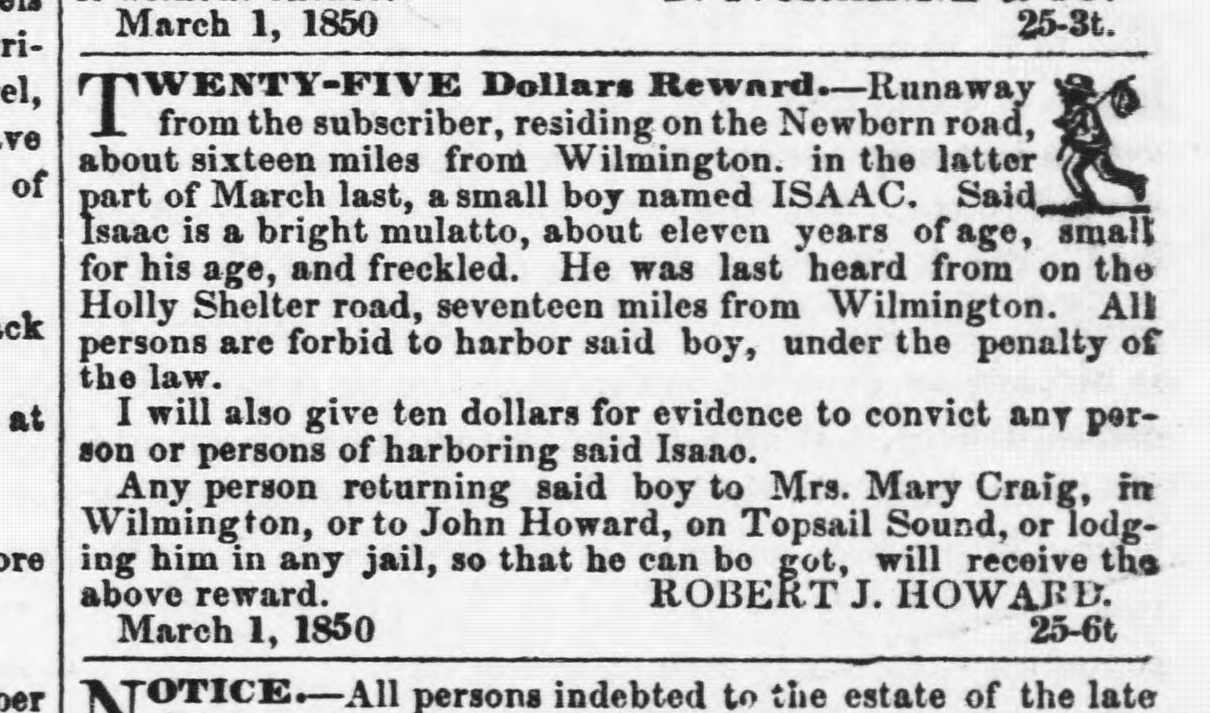
TWENTY-FIVE Dollar Reward Newspaper: Wilmington Journal Location: Wilmington, Wilmington, North Carolina, US Feb 28, 1850 $25 reward Issac - Bright mulatto ~11 yrs old Small for age Freckled $10 reward for evidence to convict anyone harboring Issac

Analysis

[Robert J. Howard Reveals the horrifying reality that even children were enslaved and subject to runaway ads. The racialized description (“bright mulatto”) shows how mixed-race children were still trapped in slavery. The additional reward for convicting harborers demonstrates how the system punished compassion and solidarity, criminalizing basic human empathy.

"Fifty Dollars Reward" runaway slave ad in The Daily Picayune newspaper - 1850

Gardner Folsom | January 18, 1850 | Freedom On The Move

Description of Source 3

Context

In the decades leading up to the American Civil War there was growing tension between Southern 'slave' states and Northern 'free' states over the question of slavery. One of the largest points of friction on a practical level was the legal status of runaway slaves. Southern slave owners saw these fugitives as their property with legal status similar to livestock and, as such, expected that these runaway slaves be returned into their control. Slaves were often even branded with their owner's mark much the same way that livestock or timber was, and still is, branded. Whenever these poor souls managed to successfully escape into the Northern free states they would often be hidden, sheltered, and supported by Northern citizens who did not see these fugitives as stray property but as wrongfully enslaved human beings. Seeing them as fellow human beings worthy of basic freedom and dignity, these Northerners would openly disregard laws that called for these slaves to be returned to their owners and would also actively disrupt the efforts of slave catchers - effectively acting as bounty hunters - to track down, capture, and return these people to Southern slave owners. Advertisements like this are a testament to this game of cat and mouse that was played for decades between slave and free states. Eventually this precarious standoff slid into open conflict initiated by Southern secession and military action at Fort Sumter in South Carolina. This led to the bloodbath of the American Civil War in which the North, through massive sacrifice and force of arms, ultimately crushed the Confederate States of America. In doing so an entire culture of chattel slavery was consigned to history on this continent and the abolition of such slavery was enshrined in the Constitution of the United States with the ratification of the 13th amendment on December 6, 1865.

Source Text/Description

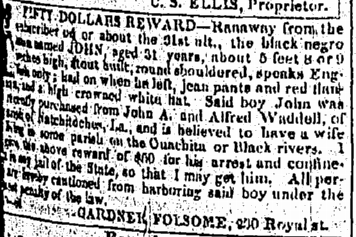
FIFTY DOLLARS REWARD Name: John 31 years old Male 5’8 or 5’9 Speaks English only Round shouldered Had on jean pants, and a high crowned white hat. Believed to have a wife living in some parish on the Ouachita or Black rivers. Enslavers: Gardner Folsome Location: New Orleans , Louisiana, US $50 Reward Newspaper: The Daily Picayune Published on January 19, 1850

Analysis

Gardner Folsome Highlights how enslaved people sought family ties even across distances, suggesting John may have fled to reunite with his wife. The ad criminalizes community support (“cautioned from harboring”), showing how laws and social pressure worked to isolate fugitives. The clothing description humanizes John in one sense, but is used to track him like stolen property.

Runaway Slave Ad in the Hillsborough Recorder - 1850

William Cain | March 12, 1850 | Freedom On The Move

Description of Source 4

Context

In the decades leading up to the American Civil War there was growing tension between Southern 'slave' states and Northern 'free' states over the question of slavery. One of the largest points of friction on a practical level was the legal status of runaway slaves. Southern slave owners saw these fugitives as their property with legal status similar to livestock and, as such, expected that these runaway slaves be returned into their control. Slaves were often even branded with their owner's mark much the same way that livestock or timber was, and still is, branded. Whenever these poor souls managed to successfully escape into the Northern free states they would often be hidden, sheltered, and supported by Northern citizens who did not see these fugitives as stray property but as wrongfully enslaved human beings. Seeing them as fellow human beings worthy of basic freedom and dignity, these Northerners would openly disregard laws that called for these slaves to be returned to their owners and would also actively disrupt the efforts of slave catchers - effectively acting as bounty hunters - to track down, capture, and return these people to Southern slave owners. Advertisements like this are a testament to this game of cat and mouse that was played for decades between slave and free states. Eventually this precarious standoff slid into open conflict initiated by Southern secession and military action at Fort Sumter in South Carolina. This led to the bloodbath of the American Civil War in which the North, through massive sacrifice and force of arms, ultimately crushed the Confederate States of America. In doing so an entire culture of chattel slavery was consigned to history on this continent and the abolition of such slavery was enshrined in the Constitution of the United States with the ratification of the 13th amendment on December 6, 1865.

Source Text/Description

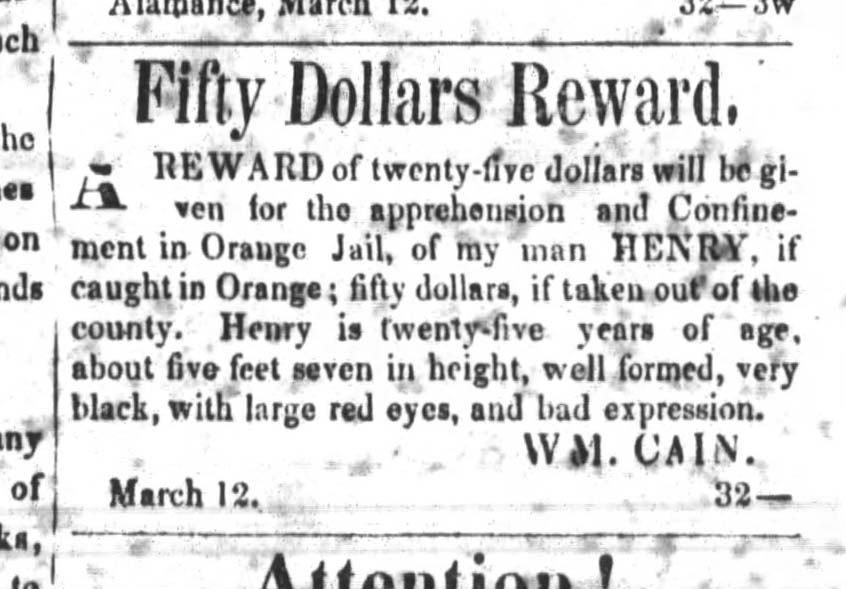
Fifty Dollars Reward. Name: Henry Male Race described as “very black” 5’7 25 Years old “Bad Expression” Large red eyes Enslaver: William Cain Hillsborough, Hillsborough, North Carolina, US Newspaper: Hillsborough Recorder Published on March 13, 1850 $50 Reward

Analysis

William Cain Shows how enslaved people were treated as fugitives from property, not as human beings. The physical description emphasizes racialized stereotypes and attempts to mark Henry as dangerous or undesirable. The tiered reward system reveals the economic logic of slavery: higher value placed on preventing escape beyond local boundaries.

Conclusion

We're glad this is in the past and that in the past it shall remain.